For decades, the question has been on the table: “Does the age at which you start learning a second language really matter?” Today, language science, neuroscience, and longitudinal studies provide an increasingly clear answer: yes. And they do so with data.
The figures not only confirm that starting early matters but also quantify how much it matters. One of the most solid indicators for measuring the impact of age on language learning is the actual probability of achieving functional fluency. Thus, a study cited in the Applied Linguistics Research Journal shows a very clear gap depending on the starting point:
Children who start learning a second language between ages 0 and 7 have a 70% to 80% probability of reaching fluency. This percentage drops to 35%–40% if learning starts between ages 8 and 12, and falls even further, to 15%–20%, when the start occurs in adolescence or adulthood (age 13 onwards).
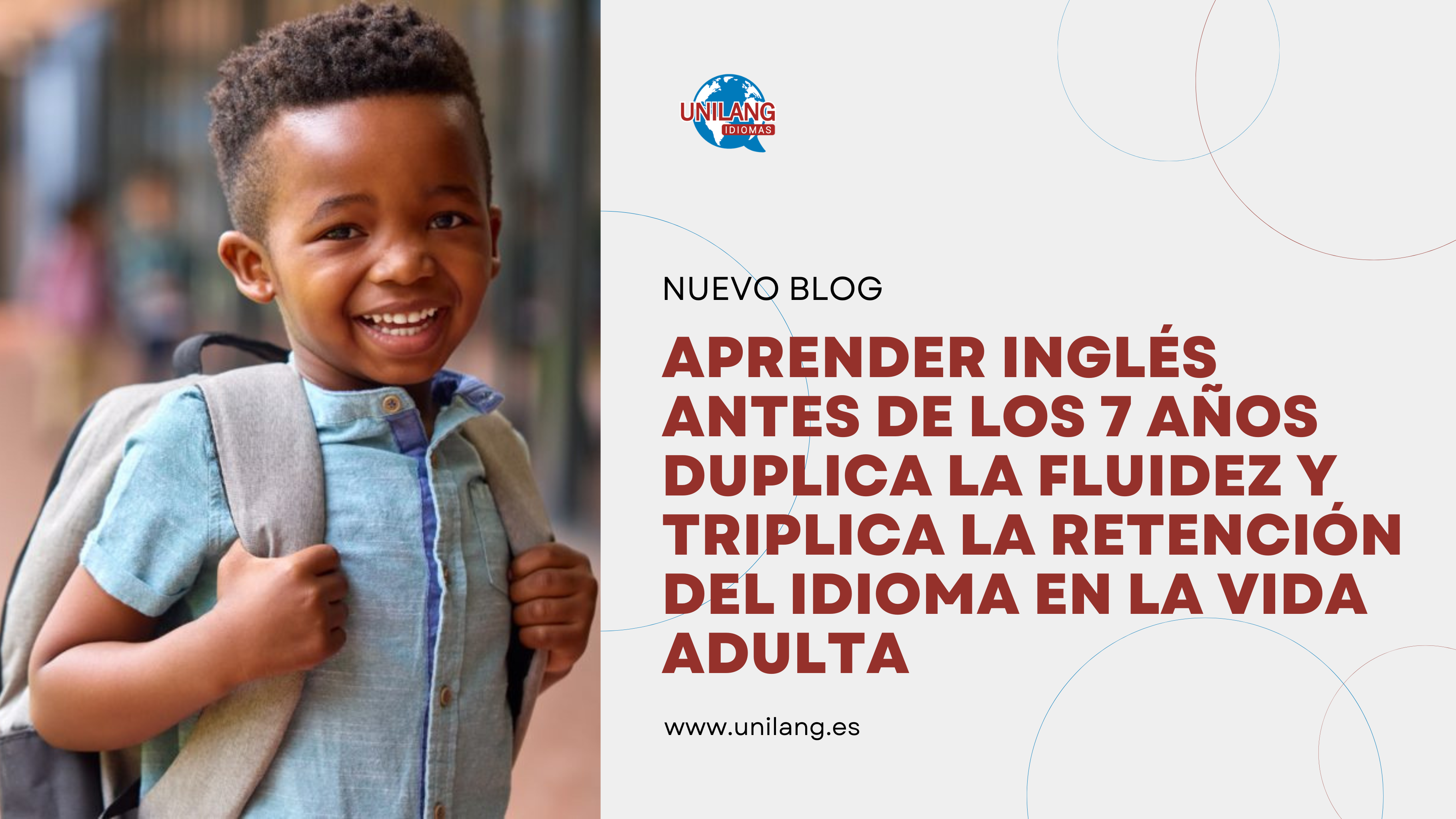
But fluency isn't everything. Maintaining the language over time is just as relevant. At this point, data from the World Economic Forum adds a key dimension: permanence.
Children who start before age 7 are 3 times more likely to maintain the language in adulthood compared to those who start later. That is, early learning not only accelerates initial progress but builds a lasting relationship with the language, something fundamental in a world where English accompanies you throughout your academic and professional life.
Where the early advantage is most visible
If there is one area where age makes an especially clear difference, it is phonetics. Research in language acquisition shows that the infant brain, thanks to its high plasticity, is capable of:
- Distinguishing sounds that do not exist in the mother tongue.
- Reproducing accents and intonations with great precision.
- Automating phonological patterns without conscious effort.
Therefore, children exposed to a second language before age 7 have a much higher probability of achieving native or near-native pronunciation, something that becomes progressively more difficult with age.
Although not all studies offer exact percentages, the evidence is consistent: the early phonological advantage is one of the most robust and least disputed in scientific literature.
Greater vocabulary range and higher grammatical precision
The benefits are not limited to accent. Various research, such as that published in the International Journal of Research and Innovation in Social Science (IJRISS) on early English learning, indicates that children who start at earlier ages:
- Develop a broader and more diverse vocabulary.
- Show higher grammatical accuracy in standardized tests.
- Construct more complex sentences more naturally.
In real language use tests—not just academic exercises—these students obtain better comprehension and production results, indicating that the language is not memorized: it is internalized.
Language as an educational engine
A longitudinal study conducted in the United States by the University of Cambridge with students from disadvantaged socioeconomic backgrounds provides a key datum: early acquisition of English predicts better academic results in fifth grade, even when controlling for variables such as economic level or previous preparation.
Students who began learning the language early obtained better results in reading comprehension, mathematics, and general standardized tests. In this context, language is not limited to being just another subject but becomes a transversal tool that enhances learning across various areas.
Unilang's Great Little People
Given this evidence, at Unilang Idiomas we have created the Great Little People method, specifically designed for children aged 3 to 6. Our approach combines face-to-face learning at the center with digital resources and educational apps for the home, so that children can make the most of the benefits of early English learning.
The method is based on small groups, with a maximum of six students per class organized by age, allowing for individualized attention without losing group dynamics. Children work comprehensively on the four language skills—speaking, listening, reading, and writing—in an environment where English is used as a tool to explore, solve problems, and handle everyday situations.
Learning takes place through five “Corners” that combine play and experimentation:
- Start Corner: Introduction to basic concepts like emotions, colors, numbers, days of the week, and simple actions.
- Phonics Corner: Learning English sounds through object manipulation, songs, and practical phonetics exercises.
- Active Corner: Motor activities, dances, experiments, and artistic games to learn while moving the body.
- Reading Corner: Promoting reading with more than 50 children's stories, storytelling, puzzles, and educational apps that can also be used at home.
- Let’s Eat Corner: Learning vocabulary related to food, hygiene habits, and first interactions in English, promoting dialogue from the very first steps.
The program lasts nine months, divided into three terms, with a one-hour weekly class in the afternoon, from Monday to Friday. Groups have a minimum of 3 and a maximum of 6 students, with an average of 6 per class.
For more information, you can contact us via the form on our website, by calling 942 224 294, sending an email to idiomas@unilang.es, or visiting us at C/ Rualasal nº 5 – 4º izda., 39001 Santander, Cantabria, Spain.